

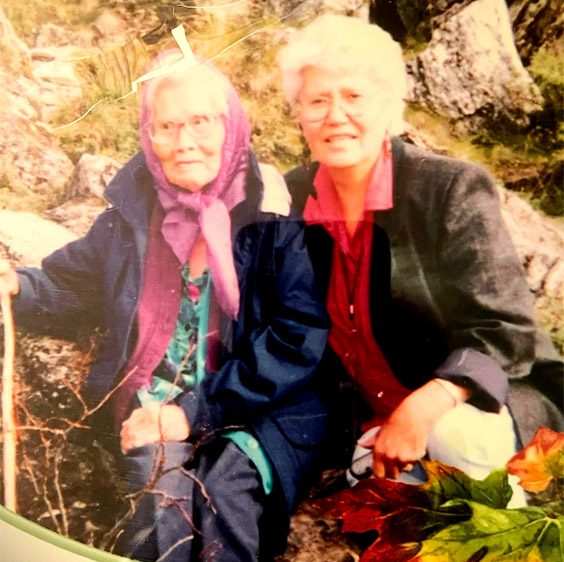
Early Life, Family, and a Life of Resilience
Growing up in Holy Cross, Alaska, Agnes was raised in a life shaped by family, culture, and the rhythm of the land and river. Her father, Pius Savage Sr., was born in Holy Cross, and her mother, Ellen Hunter, came from Shageluk on the Innoko River. After they married, they built their life in Holy Cross, where Agnes spent her childhood between the village and fish camp along the Yukon River.
Her roots run deep. Her grandfather on her father’s side was Nicholai Savage from the Kuskokwim, and her grandmother was Aniska Agnes Demientieff of Holy Cross. On her mother’s side, her grandparents were Nicholas and Jane Hunter of Shageluk. Agnes remembers being told that long ago, people often had only one name. Last names came later, sometimes given by others. Her grandfather was given the name “Hunter” by a storekeeper because he was a skilled hunter. It was a name earned.
Agnes grew up in a large, busy family. She was one of many siblings, seven sisters and six brothers and later two younger sisters came along. When her dad’s sister passed away, her parents took in her children Morgan Andre and the cola (Tina) Andre. They had a very large loving family. As one of the older girls, especially after her older sisters left for high school, responsibility came early. She helped her mom and dad raise her younger brothers and sisters. She worked alongside her parents to keep the household running.
Each year, the family moved to fish camp from May through August. It wasn’t just a seasonal activity it was a way of life. Everyone had a role, and everything depended on working together.
Lessons from Family
Some of Agnes’ strongest memories come from those early days at fish camp, where life lessons were taught through experience rather than words.
She remembers learning how to cook by watching her mother. One day, wanting to do it right, she cooked an entire sack of rice, far more than the family needed. It filled three large buckets. Her father looked at it and calmly said they would be eating rice for a few days, while her mother laughed. It was a simple moment, but one she never forgot. It taught her that mistakes were part of learning, and that humor and patience mattered just as much as getting things right.
Work was never something to question, it was simply part of life. The boys carried water. Everyone had chores. Things were done without complaint because that’s how families worked together. Looking back, she sees how smoothly everything ran, and how different it feels from today when children sometimes ask “why.” Back then, no one asked, they just did it.
In the spring, before heading to fish camp, Agnes worked closely with her father as he repaired and cleaned the boat engine. She sat her brothers in a line and she carefully laid out each part as it was removed and handed to her. Her father emphasized how important it was to keep the parts in the order that they came off. Together they cleaned them one by one and then she handed them back in the exact order. Her father taught her not just how engines worked, but how to listen to the engine and to pay attention to the sound.
That lesson stayed with her. Even now, she says, “I turn off the radio and listen to the engine when I think I hear something. You’ll know when something isn’t right.” It’s about more than mechanics, it’s about awareness, patience, and trust in what you can hear.
Her mother taught her just as much, but in a different way. When it was time for Agnes to learn sewing, her mother didn’t give her patterns or step-by-step instructions. Instead, she told her to figure it out. Agnes remembers ordering material from Montgomery Wards, thick, curly white fabric like sheepskin. She recalls staring at it when it came in, unsure where to begin.
So she came up with her own solution. She took apart a beautiful blouse she had received for Christmas, studying how it was made so she could create her own pattern. Quietly, without saying a word, she used that knowledge and that pattern to sew her own parka. Her mother later helped her with the zipper, but she never mentioned the blouse.
Her mother wanted Agnes to learn to do things herself. From that moment on, Agnes learned independence. “If I make it for you,” her mother had said, “you will never learn to do it yourself.” That lesson stayed with her for life.
Family Life
Family has always been at the center of Agnes’ life. She was married twice and raised three children, Aneska, Helena, and Calvin. She also helped raise her nephew Robert, bringing him into her home when she was just 15 years old. To her, he has always been her son.
Her family has grown over the years to include grandchildren and great-grandchildren, each one deeply cherished. Her granddaughter Samantha has two children, Linaya Sidney and Nokoa John, and her grandson Alton shares his life with Carolina, whose daughter Alajandra Agnes lovingly considers her own great-granddaughter as well.
To Agnes, caring for her family has never been about spoiling them. It is about sharing love, staying connected, and being present in their lives.
One of her favorite memories came on her 75th birthday, when her great-granddaughter Linaya spent the night. The next morning, Linaya looked at her and said, “Grandma, you’re 75! That means you have 25 more years until you’re 100!”
Agnes remembers how that statement made her feel. It wasn’t said with doubt, it was said with certainty. In that moment, she believed it too. Living to 100 didn’t feel far away. It felt possible.
Life Experiences and Work
Agnes’ first job came just before she left for high school, working with the Native Youth Corps in Holy Cross. That summer, she helped tear down an old warehouse near the current Oil Company site. Nothing was wasted. Day after day, she pulled nails from old boards, carefully saving each one in buckets. It was hard, repetitive work, but it reflected the values she was raised with - use everything, waste nothing, and take pride in doing a job well.
Not long after, she worked painting the old school in Holy Cross. She remembers the people she worked alongside—Mary, Rose, Lina, and Angela—spending their days painting classrooms together. It was simple work, but meaningful, and those memories stayed with her just as much as the job itself. When she received her very first paycheck, she didn’t spend it on herself. Instead, she gave it to her father so he could buy a fish net. That moment meant everything to her. Her father was one of the most important people in her life, someone who trusted her, guided her, and gave her responsibilities she never expected at such a young age.
That same trust showed itself again when she was still very young. When her mother had to leave for medical care, her father turned to Agnes and told her she would take care of the family. For four months, she managed a household of six brothers, two sisters, and her nephew Robert. She cooked, cleaned, shopped, and made sure everyone was cared for.
Looking back, she doesn’t remember it as being overwhelming. She remembers it feeling natural, something she stepped into because it needed to be done. But as she grew older, she came to understand just how much her mother had carried all those years. That experience gave her a deep respect for the strength it takes to raise and care for a family.
Throughout her adult life, Agnes chose to work part-time so she could be present for her children. She worked in the school system at Russian Jack Elementary as a kitchen helper and noon-duty aide, beginning in 1979 and continuing through 1999. She also spent a short time working for an insurance company.
In 1985, after her father’s passing, Agnes stepped into a role she didn’t fully realize she had been preparing for, teaching traditional Native dancing and singing. Her father had quietly taught her over the years, passing down songs and knowledge so the traditions would continue. After he passed, others reached out to her, saying he had told them she would carry it on. And she did.
The Iditarod Area School District contacted her and wanted her to teach Native dancing but her mom told her she couldn’t do it until one year after her father’s passing. She listened to her and the school district waited for her. In 1986 she began working part time with the Iditarod Area School District until 2002, traveling to villages and sharing culture, songs, and dance with younger generations. She often traveled alongside her mother, to teach and keep those traditions alive.
She continued this work until a few years before her mother passed away in 2004. After that, she stepped away. But the impact of what she carried forward, what her father entrusted to her, remains part of her legacy.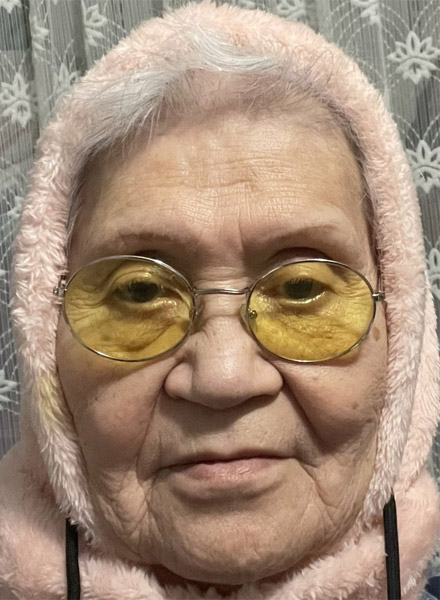
A Journey She Never Forgot
One of the most powerful lessons Agnes carries didn’t come from inside the home, but from the river.
After she had spent months caring for her siblings while her mother was away, her father gave her a choice as a reward—he would pay for her to travel wherever she wanted. Agnes chose to go to Shageluk to visit family, and she chose to go by boat.
She wasn’t alone. With her was her younger brother Pat, who was just nine years old. Even though she was older, Pat knew the river. He knew how to run the small boat and handle the five-horsepower engine. She trusted his skills.
The trip didn’t go as planned. Her father told her to borrow gas if they needed to from Jimmy Walker and sure enough Jimmy Walker was happy to help them. On the return, they floated and fished. As they reached the wide stretch of the Yukon River, darkness began to fall. It was September, and the river was rough. With only a small motor and limited visibility, they faced a long, uncertain crossing.
Pat made a decision. He told her to pull over and tie up along the bank. “Listen,” he said. She heard the big waves on the Yukon and she knew they had to stay put until the river calmed down.
They sat quietly in the dark for over two hours, listening to the river and hearing the waves and feeling the force of the current. Then he told her what to do next: they would follow the bank and go north past the village and when they could go straight across, they would. He guided the boat through the darkness, carefully avoiding debris and staying in the safer channel in the middle of the river.
Finally, they came around the bend from Ghost Creek Slough and they saw the lights of home, her heart dropped to her feet. She was sure her father would be angry. But when they arrived, he simply asked what had happened and said, “At least you made it home.”
That moment stayed with her for life.
It wasn’t just about the trip it was about trust. Her father trusted her to make the journey. She trusted her younger brother to guide them. And together, they made it home.
A Life Built on What Was Taught
Looking back, Agnes sees how much of her life was shaped by the quiet lessons of her parents. Responsibility, patience, independence, and care for others were not taught through lectures, but through living.
From cooking too much rice to rebuilding engines, from sewing her first parka to helping raise her siblings, every experience carried a lesson. And those lessons stayed with her—not just in what she does, but in how she lives.
Her story is one of resilience, but also of love, humor, and deep connection to family. It is a reminder that the smallest moments—laughter over a mistake, a quiet lesson, a child’s words can stay with us for a lifetime.
She carries her mother’s words with her still—respect others, make good choices, and live with integrity.
Today, she continues to live an active and joyful life. At 77, she stays busy, cleaning, dancing, and even playing pool. She takes pride in staying healthy and encourages others to do the same.
“We don’t have to stop living just because we get older,” she says. “Take care of your body, stay active, and keep doing what you love.”

